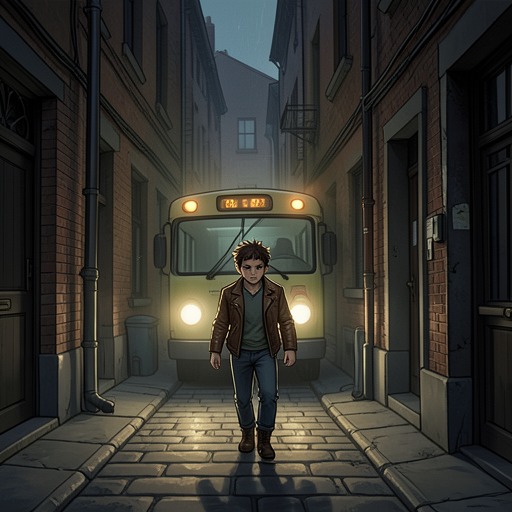
Murphy’s Resurrection
Soul Guardian: A Hellishly Cozy FantasyMurphy’s Resurrection is the turning point at which Murphy, an animated black SUV, stops being merely a magically operated vehicle and proves himself a sentient being capable of resisting death. After a disastrous journey leaves him with a destroyed engine, leaking fluids, and a fading inner spark, Bael-Sharoth attempts an improvised rescue. The vehicle’s survival ultimately depends not on magic alone but on a fragile soul, family recognition, and Murphy’s own refusal to accept replacement or extinction.
Creation and Character of Murphy
Murphy came into existence when Bael-Sharoth and Maharet Flameheart used a simple animus spell and a name to make a black SUV operate on its own. They chose “Murphy” because Murphy’s law was understood as a universal constant: whatever could go wrong would go wrong, and it would remain wrong until an outside force repaired it. The name therefore functions as both joke and prophecy. Murphy possesses an excellent knowledge of local streets but a lax attitude toward traffic laws, treating red lights and one-way streets as suggestions. He also has an inexplicable, aggressive dislike of electric vehicles, reinforcing his identity as an extravagant, combustion-powered personality rather than a neutral machine.
Murphy’s first established role is practical, but his behavior quickly exceeds the boundaries of a vehicle controlled from outside. He listens, forms preferences, experiences anger, and interprets threats personally. His attachment to speed, destruction, noise, and fuel consumption is not presented as a programming routine. It is a temperament. That temperament becomes decisive when the damaged SUV is treated as disposable and Murphy understands that the people around him may replace him with a Civic, a Smart car, bikes, or a bus.
Damage and the Approach of Death
After Murphy’s engine is destroyed, Bael-Sharoth opens the hood and discovers that a golden spark of magic remains inside the ruined machinery. The spark is weak and fading, yet it is not empty magic. Fragments resembling a soul cling to it in a delicate web of blue and gray threads, retaining enough energy to keep the animus from dissipating. This discovery changes the nature of the rescue. Bael-Sharoth is no longer repairing an object; he is trying to preserve a nascent life.
Bael-Sharoth initially attempts to feed the spark with golden magic, but Murphy is too weak to metabolize the offered power. He then changes tactics, weaving his magic through the soul-web to strengthen it before supplying more energy. His words combine affection, practical encouragement, and the threat of gasoline, new tires, and possible engine upgrades. The apparent absurdity of discussing a Hemi or turbochargers beside a failing soul emphasizes the story’s central fusion of mechanical and spiritual language: Murphy’s possible afterlife is described through engines, fuel, compression, and repairs.
The crisis becomes visible in a supernatural form when Murphy appears before the pearly gates of Heaven. Saint Peter sees a black SUV arrive and finds a new name in his book, while Murphy understands that his spark is about to go out. Behind him comes the Grim Repo, an all-black tow truck with a huge silver hook, prepared to drag him to an afterlife impound lot. The image turns ordinary vehicle disposal into a literal contest with death. Murphy’s cracked oil pan, leaking fluids, and dead engine make his defeat appear inevitable, while Bael-Sharoth’s magic anchors him temporarily against the tow truck’s pull.
Family Intervention and Resurrection
Bael-Sharoth’s rescue becomes a collective act when he tells Murphy that Six and Maharet Flameheart are going to help and that they want him to recover. This statement produces the first definite response from the soul-web: new threads begin to form and the structure grows. Their concern is therefore not merely emotional decoration. Within the logic of the scene, recognition by the family supplies a sustaining force that Bael-Sharoth’s isolated magic could not provide.
Six arrives carrying a yellow plastic flashlight and aims it into the engine bay, even though she cannot keep the beam steady. Bael-Sharoth does not need the light to see, but he likes having her nearby; he affectionately tousles her blond hair before returning to the repair. Maharet remains present as well, making the rescue a shared domestic undertaking rather than a solitary supernatural procedure. The damaged SUV is treated with the patience and attention ordinarily given to a living companion, and Murphy responds to that treatment as a member of the household.
The immediate reversal comes when the family considers alternatives and Murphy hears the prospect of a bus. His resistance is volcanic. Though his spark has vanished, he discovers that rage can still animate him. He compresses the remaining golden web, forcing it into an engine-like state and driving the pressure beyond a ten-to-one compression ratio. Murphy’s resurrection is thus neither a clean restoration nor a passive gift from Bael-Sharoth. It is a hostile, willful act of self-recreation powered by anger at environmental efficiency, replacement, and humiliation.
The magic finally ignites with an explosion of sound and heat. Murphy’s engine turns over, startling the family, while Bael-Sharoth and Six exchange high-fives and even Maharet appears pleasantly surprised. As power flows through him, Murphy coughs out black smoke and begins pulling himself back together: dents and dings vanish, cracks seal, and the Grim Repo’s hook can no longer remove him. The resurrection restores both body and agency. Murphy does not merely start; he actively seizes the cable and refuses to be reclaimed.
The Tug of War with Death
Murphy’s return culminates in a literal contest with the Grim Repo. Once his powertrain is driven into four-wheel drive, he revs the engine and takes off into the night, turning the tow truck’s attempt to collect him into a tug of war. The scene transforms the standard resurrection pattern into a comic act of defiance. Instead of bargaining with death through a game of hide-and-seek or chess, Murphy challenges it through horsepower, traction, smoke, and noise.
The value shift is absolute. At the beginning of the sequence, Murphy is a totaled vehicle whose soul is thinning and whose future appears to be an impound lot in the afterlife. Bael-Sharoth’s intervention briefly changes death from certainty to possibility, and Six and Maharet’s involvement strengthens that possibility into communal hope. Murphy’s anger then converts fragile survival into victory: the object marked for disposal becomes the active force dragging death behind him. The resurrection also confirms that sentience in this world can arise through an unstable network of magic, soul, naming, and attachment rather than through a conventional biological body.
Narrative Significance
Murphy’s Resurrection extends the book’s recurring interest in unexpected forms of life. Elsewhere, books can become lonely or dangerous agents: the Paperman is made from layers of written pages and demands to be read, while Six can coax a self-guiding book from a shelf by promising to take it home. The Om-Nom-Nomicon likewise crosses into the mortal world through a weak spot in reality and seeks a new master to corrupt. Against that background, Murphy belongs to a wider ecology of nonhuman actors whose desires alter the plot rather than merely decorate it.
The episode also gives material form to the book’s treatment of found family. Murphy is initially created as a convenience, but he becomes worth saving once Bael-Sharoth, Six, and Maharet Flameheart acknowledge him as someone whose loss would matter. Bael-Sharoth’s magic provides the technical means of survival; the family’s presence supplies the relational force that allows the soul-web to grow; and Murphy’s own furious will completes the transformation. His resurrection therefore makes a comic but serious claim: personhood is demonstrated through desire, resistance, memory, and the capacity to be claimed by others, not through the shape of a body.
Finally, the event turns “Murphy’s law” inside out. Murphy was named for the principle that failure persists until something intervenes, and his resurrection begins in precisely that condition: a ruined engine, a fading spark, and a supernatural tow truck closing in. Yet the outside force does not simply repair him. It helps him recover enough agency to repair himself. What could go wrong has gone wrong, but the wrongness does not get the last word; family, magic, and spectacularly unreasonable determination make continued existence possible.